




When Gully Boy released in 2019, its soundtrack became one of the most discussed parts of the film.
That was not simply because it had good rap songs.
The music worked because it was treated as part of the film’s storytelling.
That distinction came up in my conversation with Ankur Tewari on Pak Pak Pakao, where he broke down how he approached music supervision on Gully Boy and why understanding the rhythm of a film can be just as important as understanding the music itself.
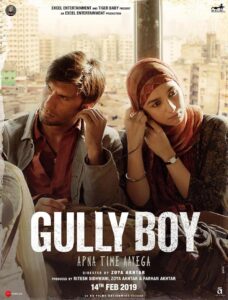
Music has to serve the story
Ankur describes his role in film music supervision quite simply: the job is to enhance the story. Sometimes music needs to be prominent. Sometimes it needs to disappear into the background.
The starting point is the director’s vision, the feeling of the scene and the overall design of the film. Ankur describes his role as that of a “sonic production designer”, using music to help establish the film’s sonic world.
That approach became particularly important in Gully Boy.
The film was about hip-hop, but that did not mean every scene needed to sound the same.
The problem with making a film about one genre.
A film centred around hip-hop presents an obvious challenge.
You have to establish the sound of the culture while keeping the audience engaged for the entire length of the film.
As Ankur explained, Gully Boy needed to distinguish between how Murad experienced hip-hop and how MC Sher approached music. But there was another problem. By the middle of the film, the audience had already heard a lot of hip-hop.
The sonic palette could become saturated.
So the solution was not necessarily another great rap song.
It was contrast.

The “Palate Cleanser” lesson
Ankur used an interesting example.
After a sustained period of hip-hop, he introduced a song that sounded completely different from the established palette. It moved towards an older Hindi film sound, with a waltz and accordion-led arrangement reminiscent of the Raj Kapoor era.
He compared the idea to a palate cleanser in food.
The purpose was to reset the listener before the film moved into its final act
This is a small musical decision, but it reveals a much bigger principle. Good film music is not always about adding more. Sometimes it is about creating space for what comes next. If every scene is designed to sound big, eventually nothing feels big.
Contrast creates impact.
Why Gully Boy needed a different approach
This is also why Gully Boy benefited from taking a risk with its musicians. Ankur credits Zoya Akhtar for making the decision to work with younger and newer musicians rather than relying entirely on established names. That decision mattered because the film itself was telling a story about a new generation of Indian hip-hop artists.
The music therefore had to feel connected to that world.
It could not simply sound like a conventional Bollywood soundtrack with rap added to it. The film needed the music to help establish its credibility. That meant taking a punt.
The filmmaker has to take the risk
Ankur sees filmmaking as a process of taking bets.
Some work. Some do not.
But somebody has to be willing to make the decision.
In the case of Gully Boy, that meant trusting musicians who were not the obvious established choices for a major Hindi film. This is an important lesson for the Indian music industry.
If filmmakers and labels only select sounds that have already been proven commercially, new music rarely gets the opportunity to become mainstream in the first place. The job of a film is not necessarily to predict what audiences will like.
Sometimes it is to introduce audiences to something they did not know they would like.
Music supervision is really about understanding cinema
Ankur’s route into music supervision also explains why he approached the role differently. While trying to build a career as a full-time musician, he worked across different film departments and also wrote scripts. That gave him an understanding of narrative flow and the rhythm of a screenplay. That experience became useful when designing music for a film.
Instead of asking only, “What song should go here?”
The question becomes:
What does the story need here?
Sometimes the answer is a rap song.
Sometimes it is an original composition.
Sometimes it is a piece of existing music.
And sometimes, as Gully Boy demonstrates, the answer is something completely unexpected.

The bigger lesson from Gully Boy
The success of Gully Boy’s music was not just about assembling talented artists.
It was about giving each musical decision a purpose.
The soundtrack established the film’s hip-hop world, differentiated characters, controlled the audience’s sonic fatigue and created moments of contrast.
That is what happens when music is treated as part of filmmaking rather than as something that sits alongside it.
For the Indian music industry, there is a useful lesson here.
The best film soundtracks are not necessarily the ones with the most songs, the biggest artists or the most commercially obvious choices. They are the ones that understand the film.
Gully Boy worked because its music sounded like the world the film was trying to build.
And sometimes, making that world convincing means knowing exactly when to break its own rules.